
Ductless Mini-Split vs Central Air: Which Is Right for Your GTA Home?

Quick Summary: Central air suits most homes that already have ductwork. Lower upfront cost, whole-home cooling, invisible system. Ductless mini-splits win when there are no ducts, when you need zone control, or when you’re adding cooling to an addition or finished basement. The right answer depends on your house, your budget, and how you live in it.
I’m Terence, a senior HVAC technician at Canada Energy Solution. I’ve been installing and servicing residential HVAC systems across the Greater Toronto Area for over fifteen years. We just wrapped up a busy spring season and I wanted to put together a proper comparison of these two systems, because it’s the question I get asked the most. If you’re trying to figure out which one makes sense for your home, I’ll walk you through what I’ve learned from hundreds of installs across Toronto, Mississauga, North York, Hamilton, and everywhere in between.
Back in last June I did a quote for a couple in East York, just off the Danforth near Woodbine. They’d bought a 1940s semi-detached, beautiful old place, plaster walls, hardwood floors, radiator heating, and it had never had central air. The previous owners used window units. Summer had barely started and the bedroom was already an oven. The main floor was tolerable. The den did whatever it felt like.
They wanted real air conditioning. They just didn’t know which kind.
I get this question constantly. And there’s no universal right answer. But there usually is a right answer for a particular house.
How Central Air Works
Central air uses one outdoor condenser connected to your furnace’s air handler. The indoor unit pushes conditioned air through your existing ductwork, distributing cooling to every room via registers in the floor or ceiling.
One thermostat controls the whole house. You set a temperature, the system runs until it gets there.
Installation, when you already have ducts, is relatively straightforward. Connect the outdoor unit, install the indoor coil, run refrigerant lines. In a typical Toronto detached or semi with existing furnace ductwork, that’s usually one full day.
How Ductless Mini-Splits Work
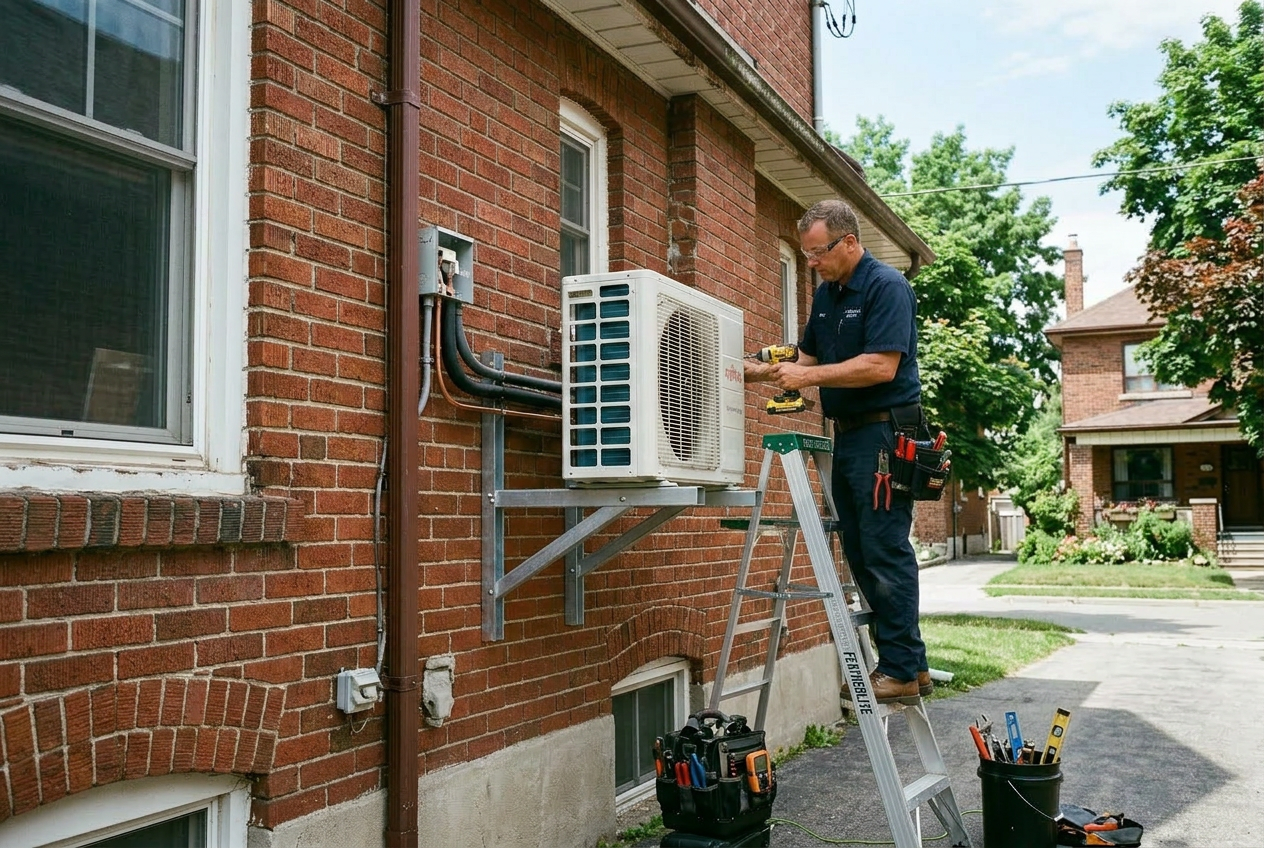
A mini-split uses the same refrigerant-cycle technology as central air, but there’s no ductwork. The outdoor compressor connects to one or more indoor wall units via refrigerant lines that run through a small hole in the exterior wall, typically 7–8 cm.
Each indoor unit has its own remote or wall thermostat. In a multi-zone setup, you might run three indoor heads independently. The bedroom at 21°C. The living room at 23°C. The den switched off entirely.
They’re efficient. No ducts means no duct leakage. Natural Resources Canada estimates that duct losses account for 20–30% of conditioned air in older homes. Mini-splits deliver cooling directly to the room, nothing lost in transit.
Most modern mini-splits also function as heat pumps. That’s a separate conversation, but worth knowing when you’re comparing long-term value.
Installation: What’s Involved and What It Costs
Central air is simpler when ducts exist. The tech runs refrigerant lines through the basement, mounts the outdoor unit on a pad, and ties it into the furnace air handler. A standard install in a GTA home runs $3,500–$6,000 depending on the unit’s SEER2 rating and whether electrical work is needed.
No ductwork? That changes everything. Adding ducts to an older Toronto home (common in pre-1970s builds with radiator or baseboard heat) can add $5,000–$15,000 and turn the project into a full renovation. Plaster walls, narrow chases, low ceilings in the basement. Some older homes simply can’t accommodate it without tearing things apart.

Mini-split installation skips all of that. Mount the indoor heads, drill a small hole for the line set, connect to the outdoor unit. A single-zone system (one indoor, one outdoor) runs $2,500–$4,500 installed. A multi-zone with three or four heads: $6,000–$12,000+, depending on brand and complexity.
For the East York couple on the Danforth, running ducts through plaster-and-lathe walls was a non-starter. Mini-split it was.
Side-by-Side Comparison
| Factor | Central Air (with ducts) | Ductless Mini-Split |
|---|---|---|
| Equipment + install | $3,500–$6,000 | $2,500–$12,000+ |
| No-duct home | Add $5,000–$15,000 for ductwork | No change, that’s the whole point |
| Operating cost | Lower with good ducts; higher with old leaky ones | Generally lower, no duct losses |
| Zone control | No (single thermostat) | Yes (per-unit control) |
| Aesthetics | Invisible (floor/ceiling registers) | Wall-mounted units visible |
| Installation disruption | Low (with ducts) | Low |
| Lifespan | 15–20 years | 15–20 years |
| Heating capability | No (cooling only; furnace heats separately) | Most models double as heat pumps |
Not sure which system fits your home? We offer free in-home consultations, no pressure, no obligation. We’ll look at your structure, your budget, and give you an honest recommendation. Contact Canada Energy Solution.
What Real GTA Homeowners Are Saying

The ductless vs. central debate comes up regularly on Reddit, and the threads are worth reading if you want unfiltered homeowner experiences.
In r/centuryhomes, owners of older homes consistently report that ductless was the only realistic option when their house had no existing ductwork. Several mentioned high-velocity systems as a possible alternative, but the consensus was that mini-splits were simpler and less invasive.
Over on r/hvacadvice, the practical feedback is similar: homeowners who went ductless in older homes praise the zone control and efficiency gains, while those with existing ducts mostly stuck with central air for the simplicity. One common theme is that zone control ended thermostat wars between family members. “My husband runs hot, I run cold, we both pick our own bedroom temperature” is a sentiment that shows up in almost every thread on this topic.
The aesthetic adjustment is real though. Mini-split indoor units sit high on the wall and have a clinical, modern look. In a character home with crown moulding and heritage trim, it can feel out of place. Some homeowners opt for ceiling-recessed cassette units that sit flush. Those cost more but disappear visually.
The HRAI (Heating, Refrigeration and Air Conditioning Institute of Canada) also has solid consumer resources on both system types. Worth a read before you commit.
Best Scenarios for Each System
Choose central air if:
- Your home already has forced-air ductwork in decent condition
- You want whole-home cooling from a single thermostat
- Aesthetics matter and you don’t want visible wall units
- You’re in a newer build or recently renovated home
Choose a ductless mini-split if:
- Your home has no ducts (radiant heat, baseboards, boiler)
- You’re adding cooling to an addition, garage, or finished basement
- You want separate zones for different family members
- You want the system to double as a heat pump for shoulder seasons
- You’re only cooling part of the house
Some homeowners do both. Central air for the main floors, ductless unit for a finished basement or a master bedroom that always runs hot. That combination works well and I install it more often than you’d think.
Ontario Rebates: What’s Actually Available Right Now
The federal Canada Greener Homes Grant closed in 2024. The federal Greener Homes Loan has also closed.
In Ontario, the current path is the Home Renovation Savings Program, delivered through Enbridge Gas and Save on Energy. Heat pump mini-splits frequently qualify for rebates under this program. Eligibility and amounts change, so confirm directly at homerenovationsavings.ca before committing.
Look for the ENERGY STAR Canada certification when comparing equipment. Both central AC and mini-split models can qualify, and some rebate programs require it.
Any contractor handling refrigerant in Ontario must be TSSA-certified. Always confirm your installer is licensed. This isn’t optional, it’s law.
We help our customers navigate whatever rebates apply to their situation as part of the consultation process. It’s not always straightforward and eligibility changes frequently.
Huge shoutout to the YouTube channel Fire & Ice Home Services for their awesome video, “Central Air HVAC System VS Ductless Mini-Splits: Pros & Cons” that you don’t want to miss.
FAQ
Is a mini-split more efficient than central air?
Generally yes, because there are no duct losses. A high-SEER2 central system narrows the gap, but in older homes with leaky ducts the difference can be 20–30%.
Can a mini-split heat my whole home in a Canadian winter?
A single-zone unit won’t. You’d need multi-zone heads or a hybrid setup with a backup furnace. Cold-climate heat pumps rated to -25°C or lower are effective for most of the Ontario heating season, but a backup is smart for the deep-freeze weeks.
How noisy are mini-split indoor units?
Very quiet. Typically 19–26 dB on low fan speed, about the level of a whisper. The outdoor unit is louder but still much quieter than a traditional central air condenser.
Do mini-splits need maintenance?
Yes. The filters in each indoor head need cleaning every few weeks during cooling season and a professional deep clean once a year. Outdoor units should be inspected annually by a tech.
Will adding central air affect my furnace?
Central AC connects to your furnace’s air handler and blower. Your furnace must be compatible, and most gas furnaces with a proper air handler are. A tech confirms compatibility during the assessment before quoting.
Let Us Figure Out What Works for Your Home
Call us at (647) 812-5200 for a free consultation, or fill out our online inquiry form. We’ve installed both systems in hundreds of GTA homes, including century-old semis where ductless was the only sane option. We’ll give you a straight answer, not a sales pitch. We respond within 24 hours.
About the Author
Terence is a Senior HVAC Technician with over 20 years of experience serving homeowners across the Greater Toronto Area. He works with Canada Energy Solution, providing expert heating, cooling, and ventilation services throughout Toronto, Mississauga, North York, Scarborough, Vaughan, Hamilton, and surrounding communities. He has installed both central air and ductless mini-splits in hundreds of GTA homes, including many century-old semis where ductless was the only practical choice.
Terence's HVAC Advice Series
- HVAC Emergency After Hours: What to Do When Your Furnace or AC Stops Working
- 2026 Central AC Installation Cost in Toronto: Full Breakdown and What to Expect
- 2026 Central Air Conditioner Buyer’s Guide for Ontario: Updated Prices, Rebates & Expert Picks
- What Size Air Conditioner Do I Need for My Toronto Home?
- Canada’s 10 Best Air Conditioner Brands & Models Reviewed in 2025 and 2026 — Part 3: Comprehensive Buying Guide
- When Tragedy Strikes Home, a Community Must Rise – Standing with the Cristillo Family
- Canada’s 10 Best Air Conditioner Brands & Models Reviewed in 2025 and 2026 — Part 2: Our Top HVAC Technician Picks and Honest Model Recommendations
Recent Posts

SickKids Needs You Right Now
HVAC Emergency After Hours: What to Do When Your Furnace or AC Stops Working
Andrew’s Law Is Now Ontario Law: One Year Later, a Family’s Fight Has Made Our Roads Safer
2026 Central AC Installation Cost in Toronto: Full Breakdown and What to Expect
2026 Central Air Conditioner Buyer’s Guide for Ontario: Updated Prices, Rebates & Expert Picks


Get a Free Consultation
Our Community Contributions

SickKids Needs You Right Now

Andrew’s Law Is Now Ontario Law: One Year Later, a Family’s Fight Has Made Our Roads Safer

When Tragedy Strikes Home, a Community Must Rise – Standing with the Cristillo Family


