
Radiant barriers in Canadian attics: I’d look at the gap

Attic Talk with Mike Sullivan, attic insulation specialist at Canada Energy Solution
Say you’re getting an attic quote for a GTA house that’s cold upstairs in January and stuffy by late afternoon in July. The quote includes blown-in insulation and a roll of reflective foil. For a conventional vented attic with insulation on the ceiling below, I’d usually leave the foil off. I’d put the money into sealing the ceiling and getting the insulation right, especially along the low edges above the outside walls. Foil comes back into the conversation if there’s a specific summer heat problem it can address, such as cooling ducts that have to stay in a sun-heated attic.
Nearly half the heat in a lab test. Half of what?
In an Oak Ridge National Laboratory test, foil stapled to the rafters cut heat flow through the test attic’s floor by 49.8% under simulated summer daytime conditions. The attic floor had R-13 fibreglass batts. The same study couldn’t establish a statistically significant winter benefit under its test conditions, and the researchers expected less benefit where the ceiling already had more insulation.
That 49.8% is for heat crossing one part of a test assembly. It isn’t a reduction in your air-conditioning bill. A claim like “reflects 97%” is a different number again: it describes the surface’s reflectance, not how much heat stops entering the rooms below. In Canada’s residential energy figures, space heating accounted for 59% of home energy use in 2023 and space cooling for 3%. Those are national energy shares, not bill shares or a forecast for your house. I wouldn’t budget for a generic percentage off a GTA cooling bill, let alone count on winter savings to pay for the job.
Trace the ducts before pricing the foil
Here’s a detail that can change my advice. If the upstairs cooling ducts run inside the conditioned part of the house, attic foil won’t fix a weak supply register or an afternoon sun problem through the bedroom windows. If the ducts cross a hot vented attic, they pick up heat on the way to the rooms. I’d have the duct joints and insulation checked first. If those ducts are sound and have to stay up there, limiting the radiant heat they receive can make sense as a separately priced summer upgrade. AtticFoil’s own customer reviews include a Georgia homeowner whose upstairs AC was in the attic. That’s a useful clue about which setup might benefit, not an Ontario savings estimate.
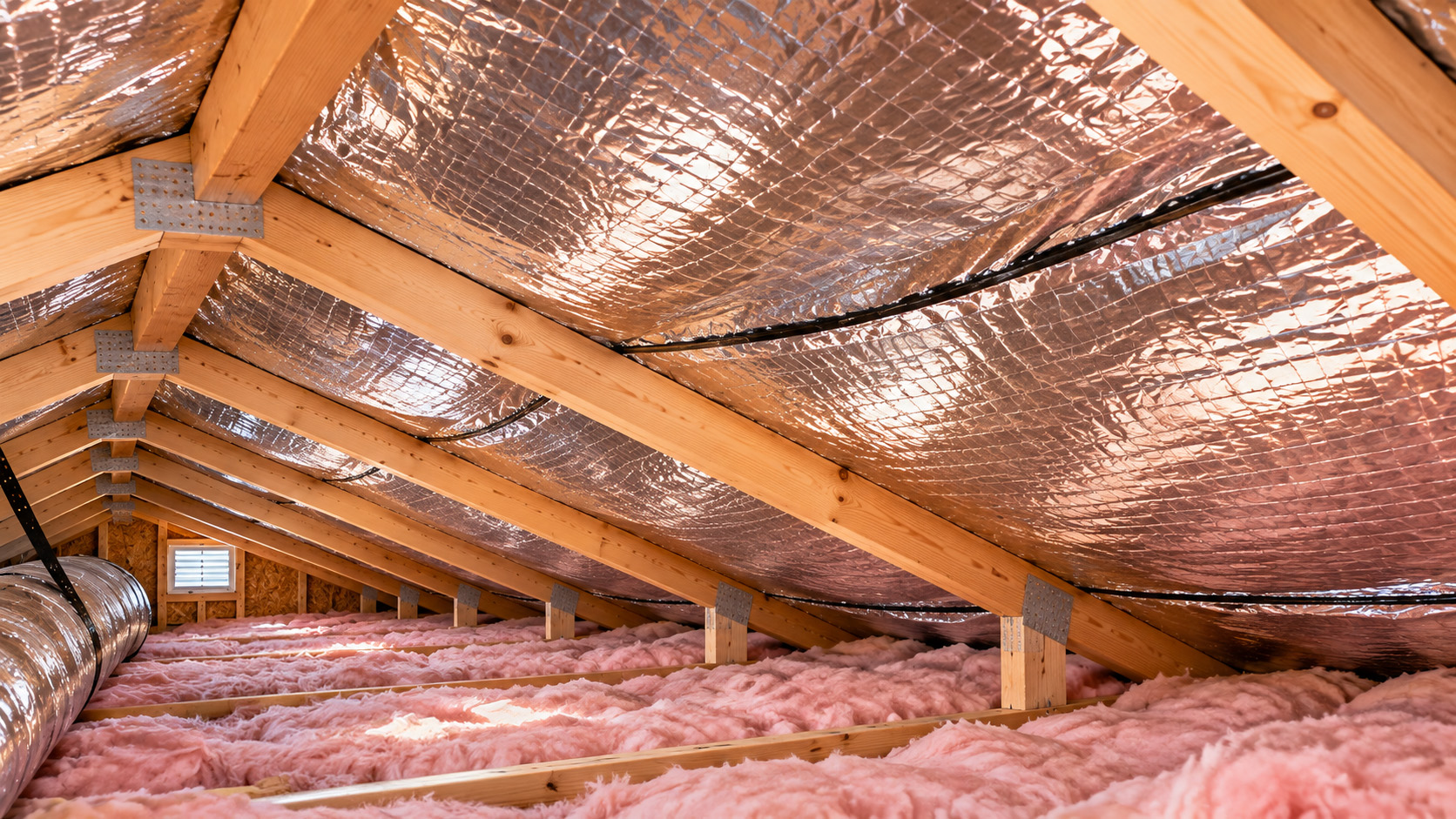
Foil under the roof deck only performs with an air gap in front of the reflective face, and it makes the most sense where cooling ducts have to cross a hot attic.
The foil needs a gap. The roof needs to dry.
Ask for a sketch of where the foil goes. The low-emittance face has to look into an air space. West Fraser specifies at least 19 mm (¾ in.) for its Solarbord roof sheathing; use the detail for the actual product, not that dimension as a rule for every roof. If that face is pressed against batts, you lose the radiant benefit on that side. If your roofer already needs to replace the decking, compare the extra cost of foil-faced versus plain sheathing. I wouldn’t pull up sound decking just to get the foil, or pay for a sheet spread over loose fill. An upward-facing sheet collects dust, which dulls its reflective surface. And on a vented roof, the sketch should show how the soffit intakes and the attic’s upper outlets, including a ridge vent if there is one, stay open.
Frost around a bath fan duct or damp roof sheathing changes the job. A homeowner discussing foil on r/buildingscience mentioned a detail that would move the fan ahead of the foil on my quote: their bath exhaust appeared to stop inside the attic. Before anyone covers damp wood, I want to know whether we’re looking at rain getting in or moist indoor air reaching cold surfaces through the ceiling or an exhaust duct.
An unperforated foil with low vapour permeance can restrict drying on the cold side. Perforations can let more water vapour through, but they won’t fix an air leak or a blocked vent. The foil at the roof isn’t a substitute for vapour control at the warm side of an insulated ceiling.
I ask for the actual product’s vapour permeance and surface-burning test results. ASTM C1313 covers properties of sheet radiant barriers. A Class A label, by itself, doesn’t tell you whether that product is suitable for your attic assembly or approved for that use in Ontario.
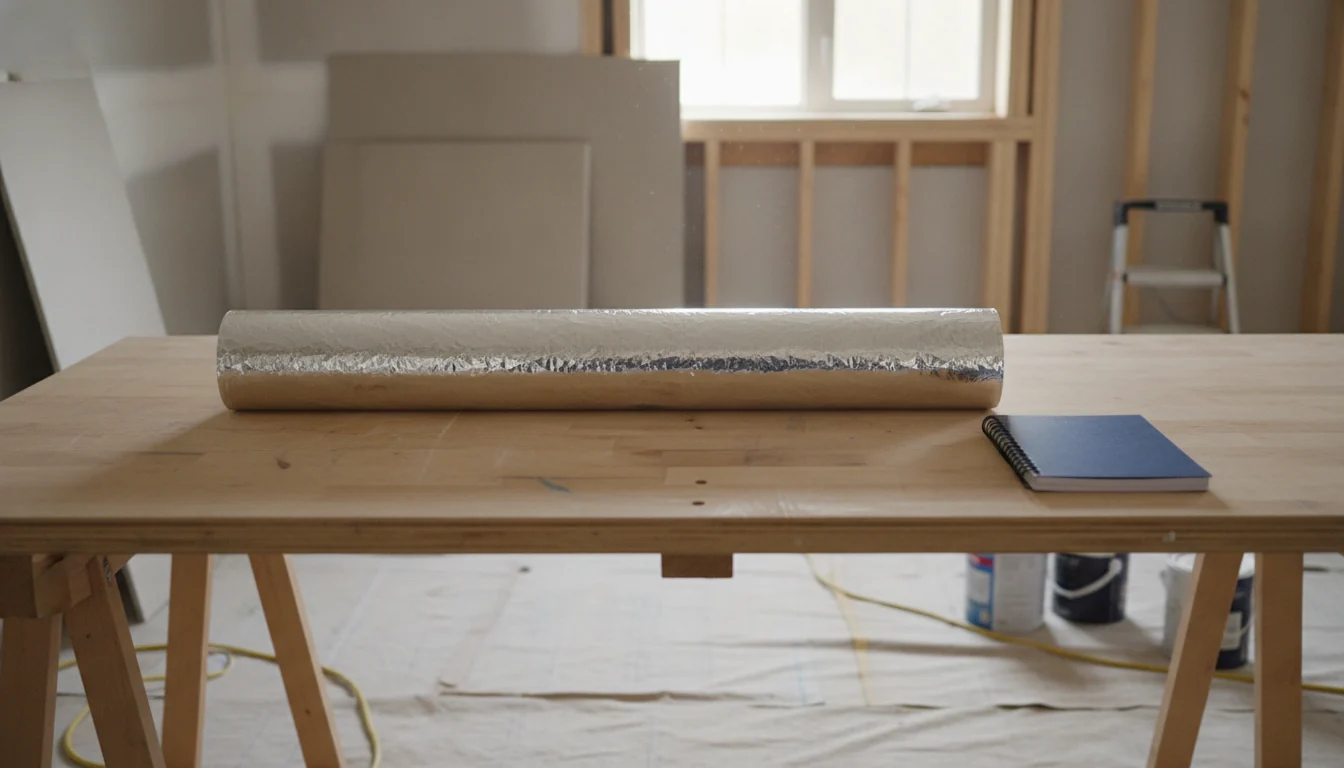
Before this roll goes on the quote, ask for the product’s vapour permeance and fire test results, and a sketch showing where the air gap sits.
What I’d keep on the quote
Have the contractor show you where the hatch and ceiling penetrations leak, and how much insulation is actually above the outside walls. A depth reading beside the hatch can miss a thin strip at the eaves. Ask for the ceiling air sealing and insulation work priced without foil, including how the crew will keep insulation out of the soffit vents. For blown-in insulation, get the target R-value and minimum settled depth in writing, including how they’ll deal with the tight spot at the eaves. If the quote counts foil toward the ceiling’s R-value, ask for a test of the assembly they’re actually proposing, with the same air space and orientation. Leave that extra R-value out of the comparison if they can’t show it.
Thanks to Jordan Smith (@JordanSmithBuilds) for sharing this jobsite demo on his YouTube channel. He aims an infrared thermometer at a bare wall panel, then at the foil-faced roof deck. The foil gives a lower reading, but the part I’d pay attention to comes a little later: the shiny face needs an air gap to cut down the heat it radiates into the attic. Press insulation right up against it and the heat has another way through.
If you’d like CES to look over your attic insulation, book a free attic assessment or call (647) 812-5200. Bring the quote and point out which room gets hot and when. That gives us a place to start before you buy anything for the roof.
Attic Talk with Mike
- Can a thermal camera spot missing insulation?
- How Much Does Attic Insulation Cost in Toronto in 2026?
- Insulate existing walls without removing the drywall?
- Attic insulation or solar panels first?
- Attic wiring and insulation: before you cover it up
- No attic vapour barrier? Don’t rush to remove the ceiling
- New attic insulation, but upstairs is still hot


Get a Free Consultation
Our Community Contributions

SickKids Needs You Right Now

Andrew’s Law Is Now Ontario Law: One Year Later, a Family’s Fight Has Made Our Roads Safer

When Tragedy Strikes Home, a Community Must Rise – Standing with the Cristillo Family


